What is the impact of the biggest interest rate cut in history on the property market, stock market and bond market?

(Image from Hailuo)
On February 20th, the quoted market interest rate (LPR) of 5-year loans was lowered by 25 basis points, and it was lowered again after 8 months, and the range was the largest ever, exceeding market expectations.
Recently, the liquidity is still abundant, and the interest rate of five years and above has been greatly lowered, which will help to further promote the recovery of the real estate industry, and also boost the stock market and bond market in the later period. The industry believes that the record downward adjustment has released a strong signal of stabilizing the property market, stabilizing growth and preventing risks.
// LPR welcomes the biggest decline in history//
On February 20th, February LPR quotation was released: the one-year LPR was 3.45%, compared with 3.45% last time; The LPR for more than five years was lowered by 25 basis points to 3.95%, and the single reduction rate reached a new high since the LPR reform, and the last one was 4.2%.
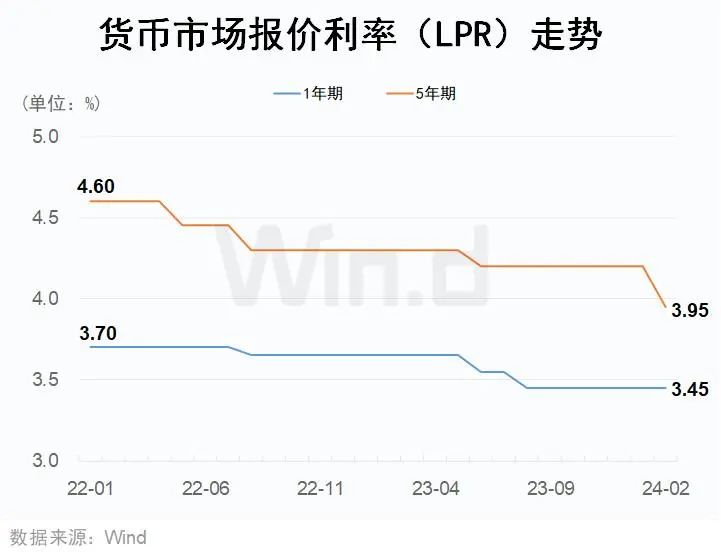
Judging from the trend of LPR in recent years, Wind data shows that the one-year period has been lowered four times in the past two years, and the rhythm of adjustment is maintained twice a year. Specifically, on January 20, 2022, it was lowered by 10BP to 3.70% from the last 3.80%, and it was lowered to 3.65% again in August, and remained unchanged for nine consecutive months from September to May 2023. In 2023, it was lowered by 10BP in June, and the quotation was 3.55%. In August, it was lowered to 3.45% separately.
In the past two years, the five-year period and above have been lowered five times, and the rhythm and one-year period are also different. Among them, it was lowered by 5BP to 4.6% on January 20, 2022, and it was lowered by 15BP to 4.45% again on May 20, and lowered by 15BP to 4.3% again in August. It has also remained unchanged for nine consecutive months. In June 2023, it was lowered by 10BP to 4.2%. In February, 2024, it was significantly reduced by 25BP to 3.95% again, which was the largest in recent years.
//The property market has been boosted//
Wen Bin, chief economist of Minsheng Bank, pointed out that the LPR over five years has been lowered by 25 basis points, which is also the largest reduction in history. Especially in the current situation of insufficient effective demand and weak expectations, it will help boost the confidence of market participants, effectively reduce the comprehensive financing cost of society and further expand the total demand.
Yan Yuejin, research director of Yiju Research Institute, believes that the real estate market in China is currently in the stage of stabilization and recovery, but the recovery process needs to be consolidated. Interest rate cuts are good for lowering the cost of capital and directly guiding the downward trend of mortgage interest rates. This interest rate cut is a relatively large one, which helps to promote mortgage application and consumption.
Zhang Dawei, chief analyst of Zhongyuan Real Estate, said that the LPR for five years or more has been reduced from 4.2% to 3.95%. If the additional factors are not considered, taking the total loan of 1 million yuan (RMB, the same below) and the 30-year equal principal and interest as an example, the monthly mortgage payment will be reduced by about 145 yuan, and the overall interest expenditure for 30 years will be reduced by more than 50,000 yuan.
According to the calculation of China Fund, if the loan is 1 million yuan, the fixed number of years is 30 years, and the principal and interest are equal, without considering the additional points, the downward adjustment of LPR for more than five years will save the interest of buyers by more than 50,000 yuan, and the monthly payment will save 1.44.8 yuan; Average capital saved nearly 38,000 yuan in interest.
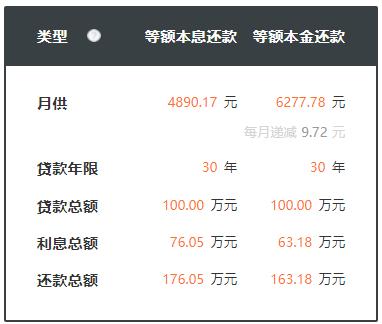
(Repayment required before downward adjustment)
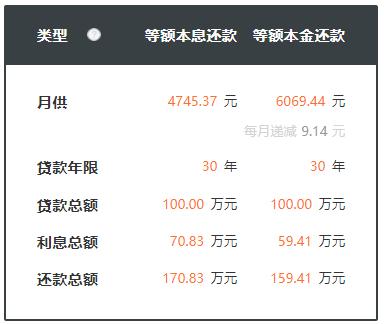
(Repayment required after downward adjustment)
Lian Ping, dean of the Chief Industry Research Institute of Guangkai, said that for the real estate market, lowering the mid-and long-term LPR benchmark interest rate will help reduce the repayment pressure of residents buying real estate and existing mortgages. As the current recovery of commercial housing sales is less than expected, the recovery of market confidence needs more policy support and patience. Based on the downward adjustment of the 5-year LPR benchmark interest rate, the mortgage interest rate of subsequent commercial banks will also respond to the downward adjustment.
//What is the impact on banking stocks? //
Many professionals believe that this asymmetric interest rate cut is generally good for the stock market. The impact of the 5-year LPR downgrade on bank spreads is expected to be generally controllable.
The soochow securities Report pointed out that there is no need to worry too much about the impact of the asymmetric reduction of LPR on bank spreads. Historically, since September 2019, there have been RRR cuts before and after the four LPR downgrades, which have buffered the bank’s costs; On the other hand, in 2023, the decline of LPR was less than that of MLF, and the banking industry made several moves to reduce the deposit interest rate, which also reserved the bank interest margin space for the separate reduction of LPR.
Wen Bin, chief economist of Minsheng Bank, pointed out that the decline of LPR over five years mainly affects medium and long-term loans. Considering the downward adjustment of deposit interest rate, the impact on the bank’s net interest margin is expected to be generally controllable.
On February 20th, the intraday trading prices of A-share banks such as Agricultural Bank and Bank of China hit a new record high.
As of the close of February 20th, the Shanghai Composite Index rose 0.42% to close at 2922.73 points. The Shenzhen Component Index rose 0.04% to close at 8905.96 points; Growth enterprise market index fell 0.01% to close at 1746.18 points, with a total turnover of 798.5 billion yuan.
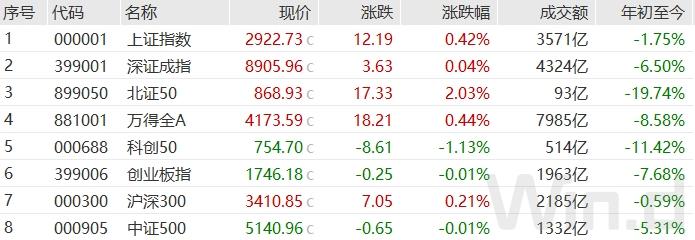
On February 20th, Wandequan A rose slightly by 0.44%, with a turnover of 798.5 billion yuan, a sharp decrease from the previous trading day. Judging from the market trend, the shock went high after the opening of the day, and the closing price continued to rise, with the bottom 5 consecutive years. The turnover of the day was significantly smaller than that of the previous days, and the market rose greatly in the short term. After the continuous rebound, both long and short sides were more cautious.
//Will the bond market take profit rebound? //
On February 20th (Tuesday), the five-year LPR cut interest rates more than expected, and the yield of spot bonds in the inter-bank market fell by more than 2 basis points in the afternoon, and the bullish sentiment rose again. As of press time, the yield of 5-year active bonds "23 Treasury bonds with interest 22" dropped by 3.35bp, and the yield of 10-year active bonds "23 Treasury bonds with interest 26" dropped by 2.4bp. Treasury futures closed up collectively, with 30-year main contracts up 0.24% and 10-year main contracts up 0.07%.
The research report from CITIC Securities pointed out that the bond market was mixed before and after LPR adjustment, and the yield of 30-year government bonds changed more smoothly than that of 10-year government bonds. In terms of horizontal comparison, before 2023, the interest rate of the bond market will even rise on the day when LPR is lowered; However, after the LPR has been lowered several times recently, the bond market yield tends to decline, and the adjustment range has narrowed.
It is worth noting that the strong correlation between LPR and MLF in the past means that the probability of co-frequency resonance is high, but the recent adjustments have shown weak correlation. This means that if MLF continues to work, the impact on the lending rate of actual financial products will be limited, but we still need to see that the capital market has been cautious about the downward adjustment of LPR over five years.
Huaan Securities’ recent research report pointed out that although the bond market is competing with each other in the short term, if the LPR interest rate is lowered recently, the take-profit sentiment may further rise.
//Release the signal of steady growth//
Luo Zhiheng, chief economist and dean of the research institute of Yuekai Securities, said that the asymmetric interest rate reduction method with one-year LPR unchanged and five-year LPR lowered, as well as the timing of interest rate reduction in February, will help protect the net interest margin of commercial banks and coordinate financial support for the real economy and prevent risks; The downward adjustment of LPR released a positive signal of steady growth, which helped boost market confidence and expectations.
According to Ming Ming, chief economist of CITIC Securities, the 1-year LPR has not been adjusted following MLF, and the reasons for the 5-year separate downward adjustment include: on the one hand, historically, the 5-year adjustment range is small, and there is a need for supplementary downward adjustment; On the other hand, since the end of last year and the beginning of this year, the central bank has achieved and met the conditions for adjusting the long-term LPR by lowering the deposit interest rate and lowering the RRR.
Wen Bin, chief economist of Minsheng Bank, said that the price difference between LPR over five years and LPR over one year is still large, and there is more room for downward adjustment of LPR over five years. At the same time, this asymmetric downward adjustment will help domestic monetary policy to give priority to ourselves and give consideration to internal and external balance.
Original title: "The biggest interest rate cut in history", what impact does it have on the property market, stock market and bond market? 》
Read the original text