[Magnificent 70 Years, Struggle for a New Era —— A Tour of Hunan’s Development Achievements, Fields and Industries] The great changes in Sanxiang depend on "foundation"
Huasheng Online August 27th (Hunan Daily Huasheng Online reporter Deng Jing Xian)
Chen Ganzhang) In the land of Sanxiang in August, major infrastructure construction was in full swing. Since the founding of New China 70 years ago, Hunan’s transportation, water conservancy, energy, information network and other infrastructure have changed with each passing day, which has become a solid foundation for the great changes in Sanxiang.
A comprehensive transportation system with external communication and internal communication, covering urban and rural areas and perfect functions has basically taken shape. By the end of 2018, the railway operating mileage of the province was 5,021.02 kilometers, 5.3 times that of 1949, and the mileage of high-speed rail increased from 606.3 kilometers in 2009 to 1,730 kilometers. The highway mileage increased from 3,142 kilometers in 1949 to 241,000 kilometers, an increase of 76.6 times, of which the expressway mileage was 6,725 kilometers.
Disaster prevention and mitigation, water resources security and power supply capacity have been fundamentally improved. More than 14,000 reservoirs of various types have been built in the province, with an effective irrigation area of 47.2 million mu. The province’s installed power generation capacity reached 45.9566 million kilowatts, and more than 6,400 administrative villages completed the upgrading of power grids.
"Flying into" the information network of ordinary people’s homes has become a "multiplier" for economic and social development. By the end of 2018, the number of Internet broadband users in the province reached 16.3532 million, 12.6 times that of 2005; There are 63.029 million mobile phone users, 22.59 times that of 2000.
121 counties (cities, districts) in the province have achieved 30 minutes of high-speed; Changsha can take high-speed rail directly to 23 provinces and Hong Kong Special Administrative Region. Changsha has become the city with the largest number of routes and the largest flight density to Southeast Asian countries in central China. More than 14,000 reservoirs of various types have been built in the province, with an effective irrigation area of 47.2 million mu. In the national 5G layout competition, Hunan is at the forefront-
threeGreat changes in Hunan depend on "foundation"
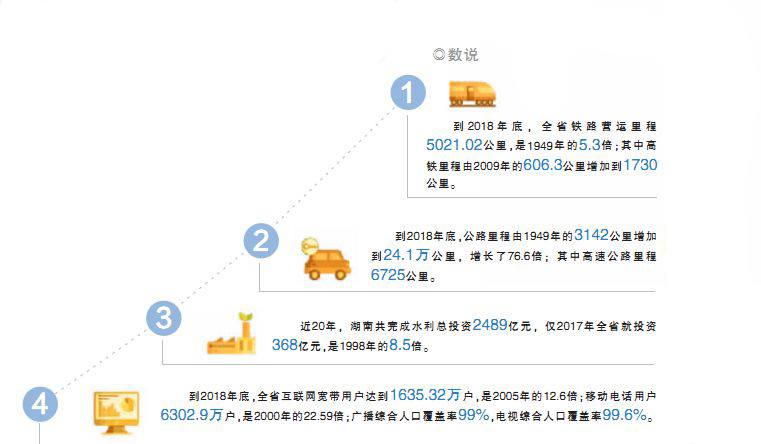
Cartography/Liu Ye
Hu ‘nan Daily Huasheng Online Reporter Deng Jing Fu Chen Ganzhang
August is the golden construction period, and the construction of key projects in Sanxiang Land is in full swing.
The construction of key railway projects such as Qianzhangchang Railway and Zhangjihuai Railway is in full swing; Seize the construction period of 11 main canal construction tenders of Qiantianhe Reservoir Irrigation District Project; In the intelligent networked automobile test area of Xiangjiang New District, Hunan Province, self-driving test cars come and go …
These major infrastructure construction projects are holding up a new situation in Hunan’s economic and social development.
Since the founding of New China 70 years ago, the infrastructure construction in Hunan, such as transportation, water conservancy, energy and information network, has been improving with each passing day, which has become a vivid portrayal of the great changes in Sanxiang and provided a solid basis for the great changes in Sanxiang.
A comprehensive transportation system with external communication and internal communication, covering urban and rural areas and perfect functions has basically taken shape.
"Going to Africa for the first time is so fresh and exciting!" Jin Dechun, a 67-year-old citizen of Changsha, accompanied by her daughter, took the maiden flight of Changsha to Kenya in June this year and spent a mysterious trip to Africa.
In an interview with reporters at the end of August, she lamented: "When I was young, it was inconvenient to go anywhere; In the past few years, I have been running around the world, and it is more and more convenient to travel. "
Jin Dechun, born in the 1950s, witnessed the fundamental change of Hunan’s transportation infrastructure from extremely backward to three-dimensional network since the founding of New China.
The Service Industry Statistics and Investigation Department of the Provincial Bureau of Statistics showed a data report to the reporter: In the 1950s, Hunan only had a railway mileage of 950 kilometers, and it was a single-track operation; The mileage of the highway is 3142 kilometers, and the road conditions are very poor; The waterway is in disrepair, with many beaches and shallow water, low waterway grade and poor navigation conditions; Civil aviation is blank.
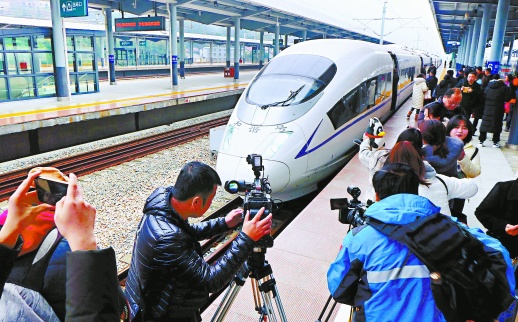
On December 26, 2017, the first train (Huaihua South to Hengyang East) operated by Huaishaoheng Railway started at Huaihua South Station. (Profile photo) Hunan Daily Huasheng Online Reporter Xu Xingshe
Stepping into the 1970s, Hunan seized the strategic opportunity that the country listed the construction of transportation infrastructure as the key point of national economic development, and went all out to promote the construction of transportation infrastructure. The road network structure was optimized day by day, the transportation system was becoming more and more mature, and the traffic appearance had undergone earth-shaking changes.
In 1972, the Hunan-Guizhou railway, which lasted for 37 years and experienced three large-scale constructions, was connected and opened a main road leading from the southwest to the eastern coastal areas.
In 1989, Changsha Huanghua Airport, the first civil airport in Hunan, set sail, which opened a brand-new opening window.
In 1994, Changyong Expressway was completed and opened to traffic, realizing the "zero" breakthrough of Hunan Expressway and opening the channel for Changsha to quickly connect with the east;
In 1999, the waterway regulation project focusing on the lower reaches of the four rivers of Hunan, Zi, Yuan and Li and Dongting Lake area was completed, and the "two vertical and one horizontal" trunk waterway network in Hunan basically took shape;
In the 21st century, modern transportation infrastructure such as high-speed rail, intercity railway, new terminal building and transportation hub station is changing with each passing day, and the three-dimensional transportation network is improving day by day.
In 2009, the Wuhan-Guangzhou high-speed railway was opened, and Hunan people took the express train of the high-speed railway at their doorstep for the first time.
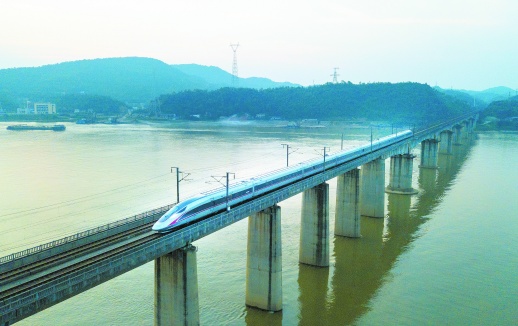
On June 26th, a Wuhan-Guangzhou high-speed train passed by Xiangjiang Bridge. Hunan Daily Huasheng Online Reporter Yan Pengbo photo
In 2014, the Shanghai-Kunming high-speed railway and the Beijing-Guangzhou high-speed railway, the two longest railways in China’s east-west and north-south directions, met in Changsha, and Changsha became the golden hub of central transportation. Today, Changsha has direct access to 23 provinces and the Hong Kong Special Administrative Region.
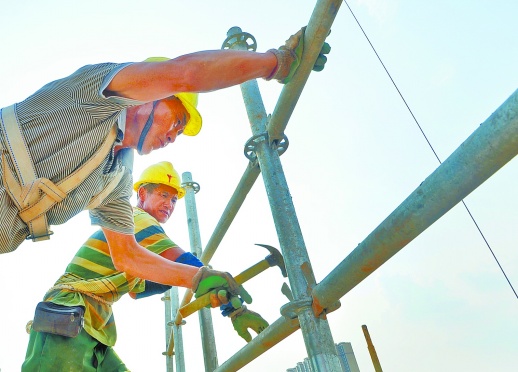
On August 6, workers were building protective frames at the reconstruction project site of Luojiazui Quanhutong overpass in Yuelu District, Changsha City.
Hunan Daily Huasheng Online Reporter Li Jian Correspondent Yu Yang Photo Report
In 2018, the Huaishaoheng Railway was opened for operation, and the Xiangxi area in southern Hunan caught a hope train. Dongkou County, Longhui County and Hengyang County have ended the history of no access to railways. This year, with Yima, Yuewang and Ma ‘an expressways completed and opened to traffic one after another, except Shimen County, 121 counties and cities in the province have achieved 30 minutes on the expressway. This year, Yueyang Airport opened for operation, and the number of airports in the province increased to 8.
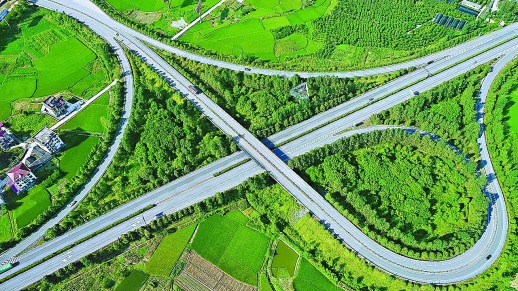
On August 2 nd, overlooking the entrance of Shaohuai Expressway, it was like butterflies flying. Hunan Daily Huasheng Online Reporter Xu Xingshe
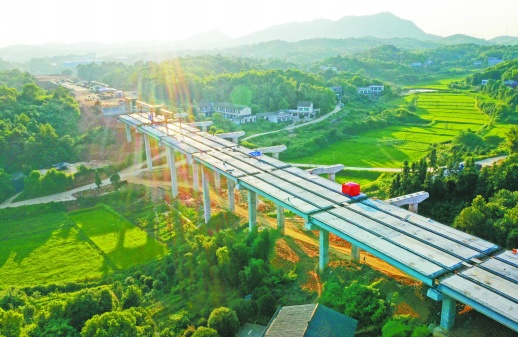
On July 26th, the expansion project of Changyi Expressway under construction was in Wangcheng section of Changsha City. The total length of the expansion project is 50.28 kilometers. At present, 80% of the subgrade engineering and bridge engineering have been completed.
Hunan Daily Huasheng Online Reporter Li Jian Correspondent Jin Mei Photo Report
The butterfly change of Hunan traffic is a vivid interpretation of the responsibility and dedication of generations of traffic people.
Hunan-Guizhou Railway, Zhiliu Railway and "One Million Militiamen Run Railways" have built remarkable great projects with the "indigenous method" of Yugong moving mountains; Aizhai Panshan Highway and Tianmenshan Panshan Highway, "pioneers" built immortal monuments of highway construction with sweat and blood; Aizhai Bridge, Chishi Bridge, Dongting Lake Bridge and Xuefeng Mountain Tunnel, with the wisdom of being the first, have created traffic miracles that set a new world record …
Up to now, a comprehensive transportation system with external communication and internal communication, covering urban and rural areas and perfect functions has basically taken shape-
The operating mileage of railways in the province is 5021.02 kilometers, which is 5.3 times that of 1949, and the mileage of high-speed rail has increased from 606.3 kilometers in 2009 to 1730 kilometers.
The highway mileage increased from 3,142 kilometers in 1949 to 241,000 kilometers, an increase of 76.6 times, of which the expressway mileage was 6,725 kilometers; The total mileage of rural roads has exceeded 200,000 kilometers, and 100% of townships and qualified villages have asphalt (cement) roads.

July 25th, Changsha Huanghua International Airport. Hunan Daily Huasheng Online Reporter Fu Cong photo
Changsha Huanghua International Airport can open to 145 airports at home and abroad, among which international and regional routes can connect 42 airports in 22 countries and regions. Changsha has become the city with the largest number of routes and the highest flight density to Southeast Asian countries in central China.
2 disaster prevention and mitigation, water resources security and power supply capacity have been fundamentally improved.
In mid-August, in the construction site of the jiepai section of the right main canal in Qiantianhe Reservoir Irrigation District of Jianghua Yao Autonomous County, the construction workers stepped up the construction under the scorching sun.
According to Jin Jinyun, the person in charge of the irrigation area project of Qiantianhe Reservoir, all the 11 main canal construction sections of the irrigation area project have been started, and more than 1,000 workers scramble for the construction period every day.
The Qiantianhe Reservoir Irrigation Area Project under construction is a national key water conservancy project, which started in October 2015. After the completion of the project, the Qiantianhe Reservoir Irrigation Area will become the largest irrigation area in Hunan, benefiting Jianghua, Daoxian and Ningyuan, which will enable 1,114,600 mu of farmland to achieve drought and flood protection and directly benefit 1.02 million people.
The construction and development of Qiantianhe Reservoir is a microcosm of strengthening the construction of water conservancy infrastructure in Hunan.
Hunan has a well-developed water system, but at the beginning of the founding of New China, only some ponds and small reservoirs were built among the three rivers and four rivers, and the ability of disaster prevention and mitigation and water resources guarantee was limited.
With the strengthening of national economic strength, the investment in water conservancy construction and management is increasing. In the past 20 years, Hunan has completed a total investment of 248.9 billion yuan in water conservancy. In 2017 alone, the province invested 36.8 billion yuan, 8.5 times that of 1998.
A number of key control projects, such as Dongjiang, Wuqiangxi, Jiangya, Zaoshi, Baiyun and Taoshui, on the main stream and tributaries of the Four Rivers in Yuanli, Hunan Province, have been built one after another. Nearly 80% of the 47 large-scale reservoir projects that have been built have been completed since the reform and opening up, which has enhanced the regulation and control ability of the four rivers and tributaries.
At present, more than 14,000 reservoirs of various types have been built in the province, with an effective irrigation area of 47.2 million mu, accounting for 76% of the total cultivated land area, which has laid a solid foundation for the development of modern agriculture and rural revitalization.
Since the end of July this year, it has been sunny, hot and high-temperature, and the province’s electricity consumption has reached a peak.
"It’s not a big problem to meet the peak summer!" At the beginning of August, Jiang Jiusong, secretary of the Party branch of Shaoshan Converter Station of Qilian-Shaoshan 800 kV DC UHV transmission project (hereinafter referred to as "Shaoshan UHV"), said in an interview that with the support of Shaoshan UHV, Sanxiang need not worry about electricity consumption this summer.

On June 24th, the "630" key project of Changsha Power Grid and the first 500 kV (ultra-high voltage) substation in Liuyang City were put into operation, which provided a strong guarantee for Liuyang area and even the whole Changsha Power Grid.
Hunan Daily Huasheng Online Reporter Yan Pengbo photo
Qishao UHV, with a total line length of 2,383 kilometers, is the first UHV DC project in the world to transport new energy power. Starting from Gansu province and passing through Shaanxi, Chongqing, Hubei and other provinces and cities, it entered Shaoshan converter station in Hunan, providing strong support for Hunan with tight power supply.
According to the Basic Industry Department of the Provincial Development and Reform Commission, in the 1950s and 1960s, the phenomenon of "stuck neck" in Hunan power grid was widespread, with a low power supply level and an installed capacity of only 2,469,500 kilowatts.
For more than half a century, our province has increased investment in power grid development, significantly improved the power supply capacity and reliability, and fundamentally reversed the power shortage situation that seriously restricted Hunan’s economic and social development.
At present, the installed capacity of power generation equipment in the province reaches 45.9566 million kilowatts, of which new energy accounts for 14%. More than 6,400 administrative villages have completed the upgrading of power grids, and the average household distribution capacity has increased from 1.0 KVA to 1.87 KVA..
3 Mobile communication and Internet broadband "fly into" the homes of ordinary people
In the relatively closed era, people get information, first by superiors or organizations, second by street talk, and third by radio and newspapers. As for the telephone, it is extremely rare. In 1978, there were less than 40,000 fixed-line telephone users in the province, with an average of one telephone for every 1,400 people.
Giving priority to the development of communication has been put on the agenda. In August, 1987, our province introduced ten thousand program-controlled telephone systems from the Federal Republic of Germany for the first time, and telephones began to "fly" into the homes of ordinary people.
On July 17, 1992, the "Mobile Phone" which started mobile communication was known to Hunan people in a jaw-dropping way-on the same day, Changsha Telecommunications Bureau publicly auctioned 30 special and auspicious numbers to the public for the first time. The number "900001" was auctioned to the 18th round, and Shuai Mingxiang, the owner of the real estate enterprise, shouted "300,000 yuan", which surprised everyone!
At the turn of the century, the banner of ".com" fluttered over every city, and mankind began to enter a broader information age, thus gaining a new "multiplier" for economic and social development.
In May, 2004, the provincial party committee and government issued the Implementation Opinions on Promoting Industrialization by Informatization. In the same year, the province’s "Village-to-Village Communication Project" was launched, requiring 100% telephone communication in administrative villages within three years.
The promotion of informatization is almost immediate. In 2006, the first report on informatization development in our province revealed that in the industrial field, the production efficiency of informatization pilot enterprises generally increased by 30% to 60%, the production cycle was shortened by 20% to 40%, and the inventory funds were compressed by 3% to 10%.
In terms of communication network construction, our province continues to promote the upgrading of optical fiber broadband networks and improve the popularization level and access capacity of urban and rural broadband networks. The continuous coverage of 3G and 4G signals has been accelerated in cities, towns and important administrative villages, major highways and urban connecting lines at or above the county level in the province, and a total of 183,000 base stations have been built. The length of optical cable lines in basic telecommunications enterprises reached 2.016 million kilometers.
In 2014, Hunan Mobile, China Unicom and China Telecom successively launched 4G commercial services. New services such as mobile e-commerce, cloud computing, Internet of Things and mobile phone reading have entered daily life in an all-round way.
By the end of 2018, the number of Internet broadband users in the province reached 16.3532 million, 12.6 times that of 2005; There are 63.029 million mobile phone users, 22.59 times that of 2000; The comprehensive population coverage rate of broadcasting is 99%, and that of television is 99.6%, which is 48.7 and 24.5 percentage points higher than that of 1985 respectively.
Today, there is an intelligent networked automobile test area with the widest coverage of 5G in China in Xiangjiang New District, Hunan Province. In the massive 5G layout competition, Hunan has already taken the lead.
Business card
1. Wuhan-Guangzhou high-speed railway
It connects Wuhan and Changsha to Guangzhou, passing through Hubei, Hunan and Guangdong provinces, with a total length of about 1,068 kilometers. It was opened on December 26th, 2009, forming a powerful, efficient and convenient passenger transportation channel in the busiest railway transportation sections in Central China and South China. Only one year after its opening, Wuhan-Guangzhou high-speed railway has created a transportation organization model with large capacity, high density and public transportation, which has spawned the "high-speed rail economy". Wuhan-Guangzhou high-speed railway is also a part of Beijing-Guangzhou high-speed railway.
2. Qiantianhe Reservoir Expansion Project
Qiantianhe Reservoir, located in the upper reaches of Xiaoshui River, a tributary of Xiangjiang River, was completed in September 1970. The expansion project of Qiantianhe Reservoir started on August 5, 2012. On December 30, 2016, the expansion project of Xiaoshui Tianhe Reservoir was impounded. The supporting project of the expansion project of Qiantianhe Reservoir-Qiantianhe Reservoir Irrigation Area Project started in October 2015, and the construction task is mainly agricultural irrigation, which will become the largest irrigation area in our province after completion.
The expansion project of Qiantianhe Reservoir has a total storage capacity of 1.51 billion cubic meters, and the estimated annual power generation is 454 million kWh after completion. By then, the flood control standard of towns on both sides of Xiaoshui River downstream of the reservoir will be raised from less than "once every five years" to "once every 20 years", which will give birth to a number of high-yield and high-quality commodity grain bases.
3. Changsha Huanghua International Airport
Changsha Huanghua International Airport started construction in 1986 and was officially opened on August 29th, 1989. The first civil airport in Hunan set sail, which opened a brand-new opening window. On July 19th, 2011, the T2 terminal of Changsha Airport was opened. On March 30, 2017, the second runway was officially put into operation. At present, the T3 terminal of Changsha Airport is carrying out preliminary work.
4. Changyong Expressway
Changyong Expressway starts from Niujiaochong, Changsha County and ends in Yong ‘an Town, Liuyang City, with a total length of 27 kilometers. In May 1993, Changyong Expressway started construction. On December 28, 1994, Changyong Expressway ran from Changsha to Huanghua, ending the history of no expressway in Hunan and shortening the drive from Changsha to Huanghua Airport. On August 20, 1995, the Huanghua-Yong ‘an section of Changyong Expressway was completed, marking the completion of the entire Changyong Expressway.
5. Changsha Metro Line 2 Phase I Project
Crossing the Xiangjiang River, across the east and west of Changsha City, from Guangda Station to Wangchengpo Station, the whole journey is 21.926 kilometers at 19 stations. Construction started on September 28th, 2009, and it was put into trial operation on April 29th, 2014. It is also the first subway in Hunan. Now in Changsha, an average of 519,500 people choose to take Metro Line 2 every day.
(Hunan Daily Huasheng Online Reporter Chen Yuzhang Deng Jing finishing)
Dictate
Collect a city with your heart
Le Bing: Expert member of Hunan Real Estate Association and vice chairman of Changsha Collection Association.
I was born in Pozi Street and grew up in Chaozong Street, and I have a unique feeling for Laochang Shacheng.
After graduating from college in 1992, I was assigned to Hunan Guoxin Real Estate Development Company, and my main job was to participate in the demolition and development of houses in the old urban area of Changsha. But every time I see old buildings being torn down, or old streets and alleys slowly disappearing, I feel a sense of disappointment. I thought at that time, can we do something to preserve the old city?
In this way, I embarked on the road of "excavating old Changsha" collection.
Let’s take a look at the old photos of Wuyi Square. On May 1, 1952, the west section of Wuyi Road was officially opened to traffic. At the intersection of Wuyi Road and Huangxing Road, a street flower bed was built, which led to Wuyi Square.
Slowly, there were more and more buildings around Wuyi Square, such as Provincial Supply and Marketing Cooperative Building, Xiangxiu Building and Wuyi Road Department Store. Although there were only three or four floors, they were landmark buildings at that time. The Sino-Soviet Friendship Pavilion, which was built in the 1960s, is the most typical Soviet-style building, and now it has become Changsha Stomatological Hospital.
In the 1980s, the street-facing units next to Wuyi Square responded to the government’s call, opened the wall to run their own shops or rented out the pavements, and the Wuyi business circle took initial shape. "Sanwang Street, Sanxing Street, Santai Street, three three get nine nine as fast as lent", "Yang Yuxing’s noodles, Xu Changxing’s ducks, and Deyuan’s steamed buns are really delicious", all of which sing the good taste of the May 1 business district.
At the turn of the century, Pinghetang opened in 1998 and Wangfujing Department Store opened in 2004, and Wuyi Square became the most prosperous central business district. Now, Metro Line 1 and Line 2 meet at Wuyi Square, and the 452-meter-tall Guojin Center, the tallest building in the province, has also opened.
These photos are a vivid portrayal of the rise of a city. I still have more than 8,000 collections of old maps, old newspapers, old magazines, old deeds, old objects, etc., which record the changes of Changsha City in the past 70 years.
It is said that Changsha is a city with mountains and rivers. Then, how many docks were there on the Xiangjiang River? I remember the "Changsha Wharf Handling Mileage Map" in the 1950s most clearly, and the answer is 67. Especially from Chengnan Road to Xiangchun Road, there are more than 50 Xiangjiang Wharf, which is the epitome of business circulation in the old city.
Of course, these docks along the Xiangjiang River have now disappeared in the long river of history. The city has developed too fast. In the past 70 years, the imprint of the past era is disappearing. If no one pays attention to it and saves it with care, it will never be found again. I hope that through my collection, I will leave more memories for Changsha.
(Hunan Daily Huasheng Online Reporter Chen Yuzhang finishing)
◎ knowledge
Changqi expressway intelligent gongdi
Hu ‘nan Daily Huasheng Online Reporter Deng Jing Xian
"It’s so scary, the steel bars are really going to hit my head. I will wear a safety helmet every day in the future!" "It’s terrible to fall from the sky. I thought I really wanted to fall off the bridge. I must be careful again in the future!"
On August 21st, Qiwan Village, Guiyang Town, Qidong County. On the same day, several construction workers were experiencing VR safety training in the first standard project department of Changchun Expressway, which started construction in an all-round way.
This is a true portrayal of Chang-Qi Expressway’s innovative construction management and the creation of "intelligent construction site" by informationization.
"We integrate the safety hazards such as falling from a height, collapse, object strike, mechanical injury and electric shock, which are most likely to occur in the construction site, into the preset virtual scene in a three-dimensional dynamic way. After wearing VR glasses, the experiencer seems to be there, thus effectively improving the awareness of safe operation in the’ life after robbery’."
Liu Jun, the project manager of the First Bid Project, told the reporter that by organizing frontline construction workers to experience VR irregularly, the safety awareness can be effectively improved.
Changqi Expressway starts from Guiyang Town, Qidong County and ends at Pengtang Township, Changning City. It is connected to Yilouheng Expressway in the west and Beijing-Hong Kong-Macao double track in the east. The total length of the main line is 32.123 kilometers, and the design speed is 100 kilometers per hour.
Different from the highway construction in the past, Chang-Qi Expressway increased the investment in intelligent technology long before it started, which greatly reduced the labor intensity of front-line workers and accelerated the project progress.
Two sections of steel bars are automatically welded by the arm of a robot, and there is no need for manual operation in the whole process-this is a scene that the reporter saw in the second standard steel bar production workshop of Changqi Expressway. This is also the first application of steel bar welding robot in expressway construction in our province.
"A robot can replace six construction workers." Liu Shujie, the chief engineer of the bid section, said that the accuracy of steel bar welding by welding robot is 10 times that of manual welding.
The reporter saw at the scene that after the staff entered the instructions, the welding robot was like a skillful "tailor", automatically welding several sections of steel bars in place efficiently and accurately.
Tang Chengtie, manager of Changyi Expressway Company, said that at present, the two sections are going all out to speed up the construction, which will ensure the successful completion of the annual target tasks. Strive to build Changqi Expressway into a high-quality, safe, efficient, harmonious and beautiful expressway by 2022.