Fuzhou takes measures to control traffic congestion simultaneously, and the density of urban road network leaps to the forefront of the country.
Many citizens will experience the trouble that the vehicles on the road line up in a "long queue" during the rush hour, but the time passes slowly.
The difficulties of the masses are the focus of the municipal party Committee and the municipal government for doing practical things for the people. In 2016, Fuzhou officially declared war on congestion and launched a special campaign to control urban traffic congestion. By the end of 2021, the length of urban roads has increased by 1.5 times, the density of urban road network has jumped to the forefront of the country, the delay index of traffic congestion has dropped from 1.73 to 1.68, the average speed of rush hour has increased from 26.45 km to 27.9 km, and the average speed of urban areas has increased by 22% year-on-year.
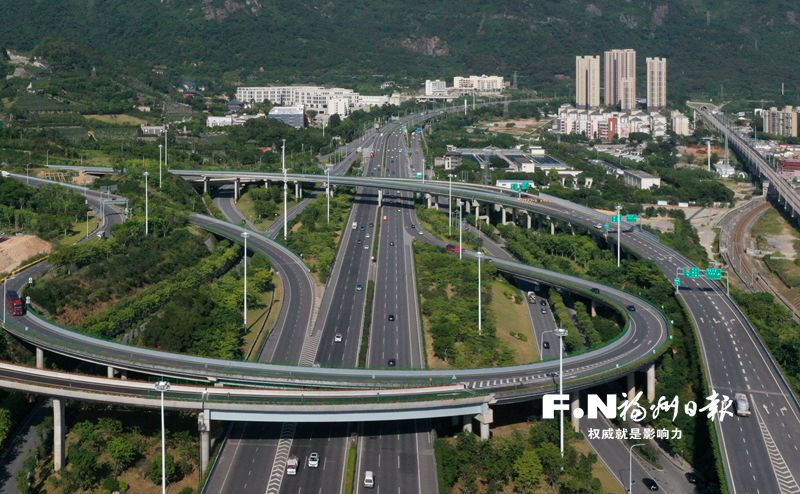 Interchange in the garden. Reporter Ye Yibin photo
Comprehensive command of "intelligent brain"
Efficient scheduling of elements
"Jinshan Avenue has five intersections in the direction of the city, and all the way is unimpeded." This is the travel experience of Mr. Sun, who lives in Fuzhou University Town, in his circle of friends.
In Fuzhou, 76% of the trips are handled by 20% of the area. The number of motor vehicles is growing rapidly and the frequency of trips remains high. What is the "password" for smooth travel? The answer is hidden in the traffic big data platform built by our city.
Taking the actual traffic situation of the whole city as the base map, integrating traffic flow detection system, traffic guidance system, signal control system and traffic simulation system to create a "smart brain"-Fuzhou public security intelligent traffic management big data platform, so that Fuzhou can sprint on the road of scientific and technological congestion.
The "smart brain" integrates all the front-end equipment of science and technology in the urban area to realize a thorough perception of the traffic conditions of people, cars and roads. "The platform can analyze 10,000 pieces of data per second and continuously calculate 860 million pieces of data every day. Through the collection, storage, analysis and judgment of the data, the monitoring, early warning and efficient scheduling of traffic flow can be realized." The relevant person in charge of the municipal traffic police detachment introduced.
"Smart brain" command, traffic lights are more "smart". Fuzhou is the first in China to realize 100% central networking joint control of traffic lights. Through the intelligent management and control platform of traffic lights, it can realize one-button remote control, automatic debugging and timing, real-time early warning of traffic changes, etc. It has changed the manual adjustment mode in the past and shortened the waiting time of motor vehicles at red lights by 20%~40%. At the same time, the "green wave traffic" is fully rolled out, and citizens can experience the "green light all the way" as long as they keep driving at a certain speed.
"Smart brain" perceives in real time, and "5 minutes" relieves congestion. The traffic police department divides the urban road network into grids, configures video grid inspectors, accurately grasps the causes of congestion and emergencies in the background, and directs the nearby mounted police to quickly remove congestion. On this basis, last year, our city piloted the "1, 3, 5" minute quick response disposal mechanism for traffic jams on the Second Ring Road during peak hours, making citizens travel more smoothly and comfortably.
"One after another" to get through the blocking point
The city "relaxes muscles and bones"
"We run on the road every day, the tunnel is widened, the road congestion pressure is less, and the trip is smoother." Speaking of the Jinjishan Xikou Tunnel, which was opened to traffic in June this year, Ge Laozhao gave a thumbs up.
As an important node of the Second Ring Road, Jinjishan Tunnel, which was completed in 1996, has only two-way four lanes, and it is increasingly stretched in the face of the surge in traffic volume. In 2015, the widened two-way eight lanes made the citizens feel "proud". In 2022, the "three-child" Xikou Tunnel was opened to traffic.
The repeated expansion of Jinjishan Tunnel is a vivid manifestation of our city’s determination to deal with the blockage. From 2016 to now, led by the Municipal Urban and Rural Construction Bureau, the city has concentrated on making up for the shortcomings of roads, and has carried out two rounds of hardware construction, generating a total of 581 projects, including the renovation of the May 4th intersection of the Second Ring Road, the renovation of Pushang Avenue (Minjiang Avenue-jinzhou area South Road), the renovation of Youxizhou North Bridge Head Interchange, and the wiring project of Xiling Interchange. The road network extends in all directions, and the city is "relaxing its muscles"-
"Ring" and "ring" are interlocked, and they are accessible quickly. In 2020, as another "one after another" connecting trunk road in Fuzhou, the connection project of Xiling Interchange Tongpan Road was completed and opened to traffic, shortening the original half-hour drive to six minutes. Focusing on "one after another" to get through major blocking points, the city has built a road network skeleton of "two rings" and "fifteen consecutive connecting passages", and the completion rate of urban planning trunk roads exceeds 85%.
From narrow and congested alleys to two-way six-lanes, the 2.93-kilometer-long road project of the northern section of Yibei Road is "full of capacity", which effectively relieves the traffic pressure on Wusi Road and Fufei Road; The south section of the extension of Industrial North Road has found another way to effectively divert the traffic of the West Second Ring Road … The denser the urban road network, the smoother the citizens’ travel.
"Our city has innovated and explored measures such as" fast forward and fast out, one after another, unblocked nodes, intersection transformation, and ensuring people’s rights "to promote the large-scale upgrading of urban road networks." The relevant person in charge of the Municipal Urban and Rural Construction Bureau told the reporter that the length of urban roads has increased from 1170.8 kilometers in 2012 to 2851.41 kilometers in 2021; The density of urban road network increased from 4.88km/km2 in 2012 to 8.05km/km2 in 2021, ranking first in China.
Nowadays, close to the green mountains and green waters, wide, flat and neat roads crisscross and interconnect, stringing together the happy "broad road" of Fuzhou citizens.

Public transport upgrading
Leading the green fashion
In August 2022, Metro Line 6 was launched, starting from Pandun Station in Cangshan, carrying Rongcheng citizens across the Minjiang River, all the way south, and arriving at Binhai New City in more than 40 minutes. "The era of good travel is coming!" The opening of Metro Line 6 has made Chen Mingna, a citizen who works in the new district and lives in the urban area, particularly excited.
The subway "joined" and public transportation was upgraded. From "unarmed land" to "four-line simultaneous development", the operating mileage of the subway in our city now reaches 110.68 kilometers, and there are 74 stations (four interchange stations), with an average daily passenger flow of 400,000, which fully demonstrates the unique charm of the subway.
Developing a modern public transport system is an internationally recognized good way to slow down traffic jams. In the past ten years, Fuzhou Municipal Transportation Bureau has made great efforts to develop public transportation. The number of vehicles has increased from 3,408 to 4,702, and the number of lines has increased from 199 to 319. The proportion of new energy buses is 82.0%, and the density of bus network is 3.4 km/km2. You can get on the bus within 500 meters of going out of the city.
Wisdom blessing, cracking "waiting for the car is difficult" and "waiting for the car is slow". Our city has successively launched customized bus, feeder line, commuter express line, peak express line, holiday line, 7686 line, loop bus and other special service modes to meet diversified needs. There are more than 20 subway connection lines in the urban area, which feed passengers with the subway and jointly build a green and smooth circle.
Zhao Ying, a citizen who lives in Wushan County, Rongfa, is full of happiness: "The subway is connected to the No.25 line at the door of our house, and we made a special trip to punch in the Liangcuo historical and cultural block. It’s so convenient. We will take the subway to visit Fuzhou every weekend to’ get through’ Rongcheng."
"Smart cars, smart roads" contribute to digital solutions for slow congestion. Thanks to the "smart brain" construction of public transport, our city has explored the "mix and match" and peak emergency dispatching mode, and intelligently dispatched schedules according to real-time passenger flow data and road conditions. The traffic efficiency has continued to rise, and the phenomenon of slow waiting for the bus and being unable to get on the bus has been greatly alleviated.
"One road, one policy" and flexible response to "parking difficulties". Since last year, Fuzhou traffic police have launched a number of parking management convenience measures: temporary parking is allowed in the streets and lanes at night without affecting traffic, benefiting 100 thousand vehicles every day; More than 12,000 parking berths have been designated to facilitate public parking; Connect the intelligent parking system to 477 parking lots in the urban area.
Five departments of our city recently jointly issued the Implementation Plan for Promoting the Development of Urban Parking Facilities in Fuzhou. By 2025, Fuzhou will add more than 20,000 public parking spaces, build five large interchange parking lots, and build five urban traffic "micro-hubs" with bus interchange, motor vehicle and non-motor vehicle parking functions.
Looking forward to the blessed state, the thoroughfare, the wheels rolling, all the way, is playing a vivid "symphony" of modern international city construction!
Wonderful review
In 2012, the main line of the Third Ring Road with a total length of about 50 kilometers was opened to traffic, which is the longest urban expressway in our province.
In 2016, a special campaign to control urban traffic congestion was launched, and a working group on urban traffic congestion control in Fuzhou was established.
On May 18, 2016, the southern section of the first phase of Fuzhou Metro Line 1 was put into trial operation; On January 6, 2017, the first phase of the northern section was put into trial operation.
In 2017, the Hualin Elevated Cross-station East Road Project was completed as the first batch of slow blocking projects, and the traffic nodes from the Second Ring Road to the Third Ring Road were opened.
In 2017, the intelligent control platform for traffic lights independently developed by the Traffic Police Detachment of the Municipal Public Security Bureau was launched, making Fuzhou the first city in China to realize 100% central network joint control of traffic lights and the first city to formulate the Principles and Standards for the Timing of Urban Traffic Lights to implement standardized timing.
On May 30, 2017, the intelligent dispatching system of Fuzhou Public Transport Group was fully launched, and all the more than 3,800 buses operated by the Group (including Kangchi New Bus Company) were intelligently dispatched.
On April 11, 2019, Kangchi Company opened the first batch of subway lines connecting No.1 and No.2 in the province, which indicates that Fuzhou has officially entered the era of "micro-bus".
In 2021, the outer ring road of Xindian, known as the "3.5 Ring Road", was completed and opened to traffic, and the main line was used as an expressway to realize the series function of urban traffic external contact.
In 2021, the "1, 3, 5" minute rapid response mechanism for traffic congestion during the peak hours of the Second Ring Road (7: 00 to 9: 00 and 17: 00 to 19: 00) will be introduced.
In 2022, the "four-ring road" scheme in the urban area was put forward to form a toll-free municipal express ring road connecting the central city of Fuzhou and Binhai New City in series. (Reporter Zhu Wei Trainee reporter Wu Huazhen)
Source:Fuzhou daily